International Display
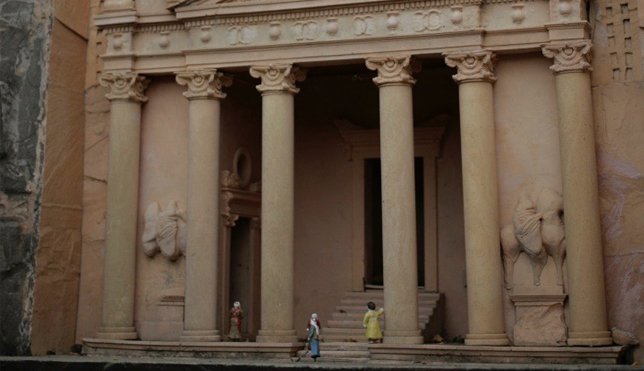
JORDAN – THE TREASURY (EL KHAZNEH) PETRA
Location: Petra
Sponsored by: The Ayash family, Ayoub Supply Company and the Jordanian Community of Sydney.
With funding assistance from Aus-industry Australian tourism development program.
Model Construction by: Cockington Green Gardens
Scale: 1:50
Construction Time: 1200 hours
Display History:
Petra is one of the world’s great historical sites laced with centuries of incredible stories of human habitation and creation. Confirmation of its great importance is found in UNESCO’s description of the ancient city as “one of the most precious cultural properties of man’s cultural heritage”.
Al Khazneh is Petra’s most famous edifice whose function during Nabataean times remains largely unknown although believed to have been the mausoleum of the Nabatean King, Aretas IV Philopatris in the 1st century AD. Carved out of sandstone rockface, the structure is some 50 metres high and 30 metres wide and is seen as one of the most elegant remains of antiquity. The interior is surprisingly small although its persona is huge. Movie buffs will immediately recognize this spectacular site from the movie, “Indiana Jones and the Last Crusade”.
The name of Al Khazneh (The Treasury) is purported to have come from Bedouins in the early 19th century believing the structure contained treasures. The model at Cockington Green Gardens was sponsored by the Ayash family, the Ayoub Supply Company and Jordanian Community of Australia, along with the support of the Australian Government’s tourism development program.
Did you know:
World Heritage Listed: 1985
Site area: 264km2
No. of monuments in Petra: 80
Petra rediscovered: 1812 by Johann Ludwig Burckhardt
LITHUANIA – THE TRAKAI CASTLE
Location: Trakai (27km west of Vilnius)
Sponsored by: Canberra Lithuanian scouts “Baltijos Tuntas”, Veterans’ Group “Zidinys” with assistance from the Canberra Lithuanian community.
Model Construction by: Mindaugas Mauragis
Scale: 1:50
Construction Time: Unknown
Display History:
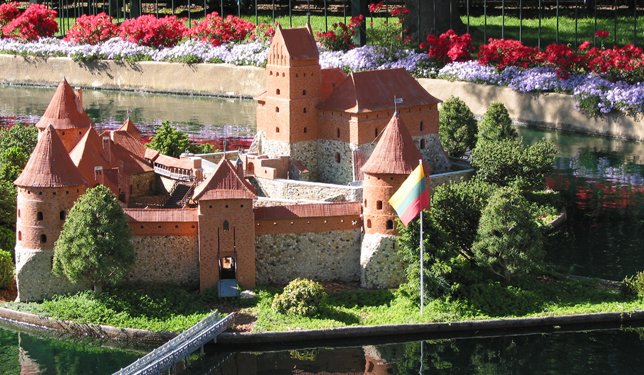
Situated on Galvé Lake, construction of the Island Castle began in the second half of the 14th century by Grand Duke Kęstusis and was concluded in the early 15th century by his son, Vytautus. Built as a fortress, the Island Castle was never conquered by raiders and thus its purpose was achieved.
Notwithstanding, as with many historical sites throughout the centuries, the structure has been subject to considerable damage and decay over the course of its existence. Following the defeat of the Teutonic Order at the Battle of Grunwald in 1410, the Island Castle became the residence of the Grand Duke Vytautus the Great. Trakai Castle lost its military and residential functions by the 16th century and was seldomly visited by the Grand Dukes from that time.
Serving as a prison and then suffering damaged during the 17th century wars with Muscovy, the decay of the Castle escalated, and it gradually fell into disrepair. Romanticism ideas in the early 19th century saw the commencement of the Island Castle’s resurrection. In 1905, Imperial Russian Authorities attempted reconstruction as did the Germans during the First World War. Major reconstruction, repair and conservation took place following World War II returning a 15th century style to Trakai Castle.
The Canberra Lithuanian Scouts (Baltijos Tuntas), the Veterans’ Group (Zidynis) with assistance from the Canberra Lithuanian community have sponsored the display at Cockington Green Gardens.
Did you know:
Lithuanian Independence: Restored 11th March 1990
Trakai Island Castle Building Style: Gothic with Romanesque features
Vytautus the Great: Died in the Trakai Island Castle in 1430
No. of Islands on Lake Galvé: 21
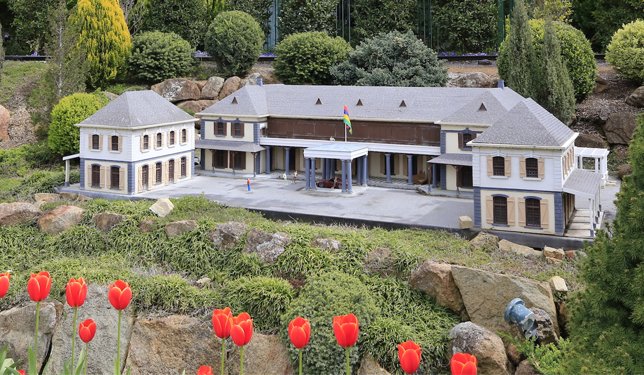
MAURITIUS – CHATEAU LE REDUIT
Location: Réduit, Moca
Sponsored by: Government of Mauritius (Website)
With funding assistance from Aus-Industry Australian Tourism Development Program
Model Construction by: Cockington Green Gardens
Inaugurated by: The Honourable DR Arvin Boolell, Minister of Foreign Affairs, Regional Integration and International Trade, Republic of Mauritius
Scale: 1:25
Construction Time: 2000 hours
Display History:
Château Le Réduit or The State House is today the official residence of the President of Mauritius after originally being constructed in 1748-49 by the Governor of the Isle de France, Pierre Félix Barthelemy David as a fortress from which to defend attackers. This was at a time of rivalry between the French and the English for colonial possessions in the Indian Ocean.
From around 1764, Château Le Réduit served as the residence of Governors of Mauritius, both French and British. The property was subject to many modifications from 1764 to 1778. White-ant damage after this time left the Château in ruins and subsequently requiring significant restoration. The British took control of the island in 1810 and further modifications and repairs to the building were undertaken from that time as well as significant attention given to the grounds by leading botanists.
In 1921, Governor Sir Hesketh Bell who had taken an interest in the gardens of Le Réduit had a memorial established in the grounds to Pierre Félix Barthelemy David. The memorial is named Le Temple de l’Amour with a marble inscription of the floor of the memorial which reads, “TO M. BARTHELEMY DAVID / Gouverneur de I’Isle de France 1746 / the creator of Le Réduit / his Grateful Successors.”
An open day once a year provides the public with access to the Château and gardens, a day which includes a garden show and recreational and cultural activities. The display at Cockington Green Gardens is sponsored by the Government of Mauritius and was inaugurated by Dr. Arvin Boolell, Minister for Foreign Affairs, Regional Integration and International Trade for the Republic of Mauritius.
Did you know:
Mauritius Independence: 12th March 1968
Capital of Mauritius: Port Louis (150,00 people)
Mauritius first known as: Dina Arobi (by Arab sailors, circa 975AD)
Total area of country: 2,040km2
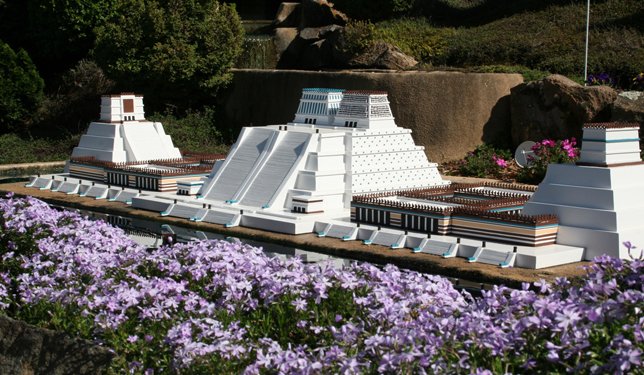
MEXICO – TENOCHTITLAN AZTEC TEMPLE
Location: Mexico City
Sponsored by: Embassy of Mexico
Model Construction by: Cockington Green with the assistance of Mrs Gabriela Steger & Mrs Dominique Tarud
Scale: 1:100
Construction Time:
Display History:
Founded on 20 June 1325, Tenochtitlan was a city-state in what is now the centre of Mexico City. It was the spiritual and physical heart and capital of the expanding Aztec empire until it was captured by the Spanish in 1521.
The most important buildings of Tenochtitlan were situated in the centre of the city, the headquarters and residence of the ruling group. The ceremonial precinct was in a quadrangle measuring more than 300 metres in length. The enormous pyramid of Templo Mayor, the main temple of Tenochtitlan, that served as the base for the twin temples of Tláloc and Huitzilopochtli was outstanding in size. It had a double stairway flanked on either side by low sold balustrades.
Tláloc was the God of Rain and Huitzilopochtli was not only the God of War and Sun, but the patron of Tenochtitlan and God of the Aztecs. The Aztec history was one of integration and rejection until they finally found an omen which indicated where they should settle indefinitely, that omen being an eagle devouring a serpent on top of a cactus. It was in that spot that they founded their capital, Mexico-Tenochtitlan in 1325 A.D.
The ruins of Tenochtitlan are part of the World Heritage Listing of the historic centre of Mexico City with Templo Mayor being destroyed by the Spanish conquerors after 1521 to make way for a new cathedral.
Did you know:
World Heritage Listing: 1985 (Mexico City Centre including ruins of Tenochtitlan
Mexico City: 6th largest city in the world (21 million people)
Population of Tenochtitlan: Approx. 200,000 to 300,000 at the time of Spanish arrival (1519)
Area of Tenochitlan: 13.5km2 (combined with Tlatelolco)
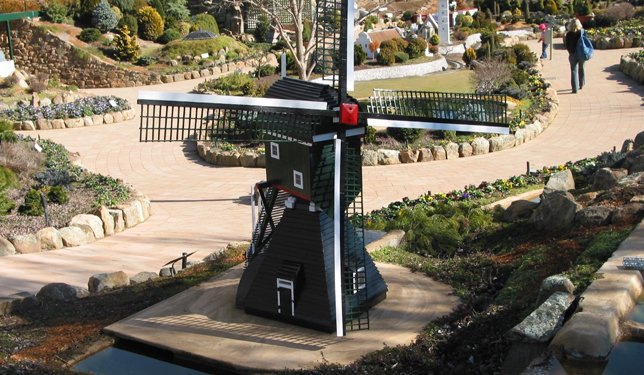
NETHERLANDS – BINNENKRUIER’ WINDMILL
Location: Noord Holland Province
Model Construction by: Mr Peter Spronsen
Scale: 1:10
Construction Time: Unknown
Display History:
Pepper and salt, bread and butter, tea and coffee, gin and tonic, Kath and Kim, Holland and Windmills – some things immediately come to mind when thinking about items that go together.
With over 1,000 windmills to be found in the Holland region today, the windmill is unquestionably the one thing that would cross the minds of most when thinking about this fascinating part of the Netherlands, a country with so much history and tradition. The low-lying lands of Holland region made it necessary to find a way to ensure that water could be removed from the lowlands and back into the rivers and dikes to allow land to be farmed.
The Binnenkruier Windmill was a variation on the standard windmill in that the sails can be turned into the wind with a mechanism. One such windmill is the Mill De Twiskemolen (Twisk-mill) in the principality of Landsmeer in North Holland. Windmills are becoming more difficult to operate in areas of increased development because the height of surrounding buildings reduces the ability of some windmills to catch the wind.
Once a year on the second Saturday of May, Holland conducts National Mill Day when around 600 windmill and watermills open their doors to visitors.
Did you know:
Area of Holland Region: 5,488km2
Holland’s Highest Point: Approx. 55 metres (180 ft above sea level)
Population of Netherlands: 17.1 million
Population of Holland: 6.5 million