International Display
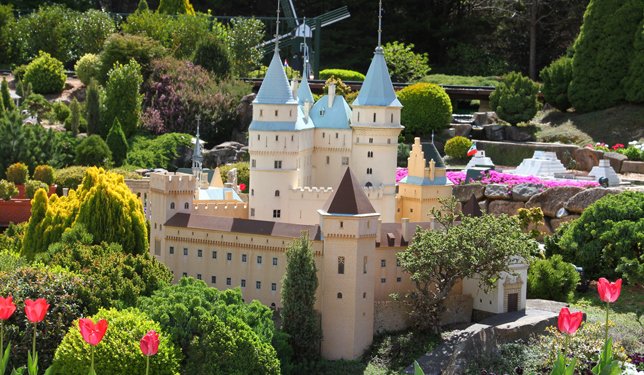
SLOVAKIA – CHATEAU OF BOJNICE
Location: Bojnice, Trenčίn
Sponsored by: Embassy of the Slovak Republic
(Click through to Embassy website)
Model Construction by:
Cockington Green Gardens
Scale: 1:50
Hours to Complete: 2500 hours
Display History:
Château de Bojnice is one of Slovakia’s most visited attractions and is first mentioned in written records in 1013 although construction is said to have commenced in the 12th century. It began life as a wooden fort but was gradually replaced by stone with the outer walls said to match the uneven rocky terrain where the building was sited. The Castle’s first owner was Matthew III Csák, a Hungarian oligarch who ruled de facto independently various parts of medieval north-western Hungary (large parts of today’s Slovakia).
The Château has had numerous owners and occupiers during its lengthy history including Czech entrepreneur, Jan Antonίn Baťa, owner of the shoe company, Bata who acquired the property in February 1939. The property was confiscated by the Czechoslovak government in 1945 when it became home to various state institutions. A huge fire broke out in 1950 resulting in substantial repairs that eventually saw the building become part of the Slovak National Museum.
The property has been the scene of numerous movies with its enchanting fairy-tale appearance and the sheer beauty of the castle setting. It is also periodically the home to the International Festival of Ghosts and Spooks where ghosts, spooks witches and vampires from around the world gather.
Australian and Slovakian ties are extremely strong in that the first person to be naturalised under the Australian Citizenship Program on 26th January 1949 was Jan Jandura, a Slovakian. A park in O’Connor in the ACT is named after Mr. Jandura to commemorate this significant event.
Did you know:
Velvet Revolution: Ended communist rule in Czechoslovakia in 1989
Velvet Divorce: The peaceful separation of the Czech and Slovakian Republics resulted in Independence for Slovakia on 1st January 1993
Slovak Population Density: 113 people per km² (Australia – 3 people per km²)
Major Industry: Motor Vehicle Manufacturing (43% of industrial output
SLOVENIA – HOMESTEADS
Locations: Kranjska Gora, Gorišnica, Divaæa
Sponsored by: Embassy of the Republic of Slovenia
Model Construction by: Cockington Green Gardens
Scale: 1:18
Hours to Complete: 1000 hours
Display History:
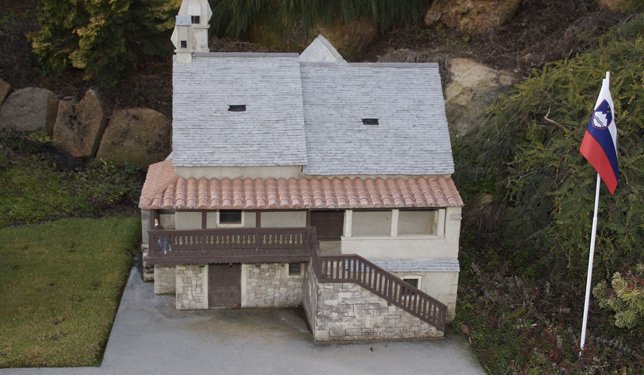
This country of incredible beauty contains properties of diverse architectural style reflecting the differing aspects of Slovenian culture, geography, and socio-economic background. Liznjek House, dating back to 1796, was the richest homestead in Kranjska Gora with its 84 hectares of land. It is considered the finest example of vernacular architecture in the area, virtually untouched from its beginnings. Today it houses an ethnological museum collection and is a declared local cultural monument.
Dominko Homestead is an L-shaped building with a thatched roof. It is the oldest preserved homestead of the Pannonian style at around 300-years-old. The living quarters of the building and the outbuildings are under the same roof-line. In 1998, local villagers renovated the historic property and created an open-air museum. The furnishings of the property, the tools and numerous objects represent farm life on the Ptuj Plain in the 19th and 20th centuries.
Divaca, a small town in the midst of the Slovene Karst region is home to Skratelj homestead with its rich architectural style. The homestead consists of three buildings, Skratelj house, the former stable and the former store. The main building was the birthplace of Slovenia’s first and internationally acclaimed film actress, Ita Rina. Today, the first floor of the homestead’s house has a permanent exhibition dedicated to Ita Rina. It is, however, the blend of the old and new architectural features and the juxtaposition of the property with nature that ensures Skratelj homestead is on centre stage.
Did you know:
Joined European Union: Slovenia joined the EU on 1st May 2004
Independence: 25th June 1991 from Yugoslavia
Slovenian Population: 2.08 million
Area of Slovenia: 20,140km²
SOUTH AFRICA – GROOTE CONSTANTIA
Location: Constantia, Cape Town
Sponsored by: High Commission of the Republic of South Africa (Website)
Model Construction by: Cockington Green Gardens
Scale: 1:18
Construction Time: Over 450 hours
Display History:
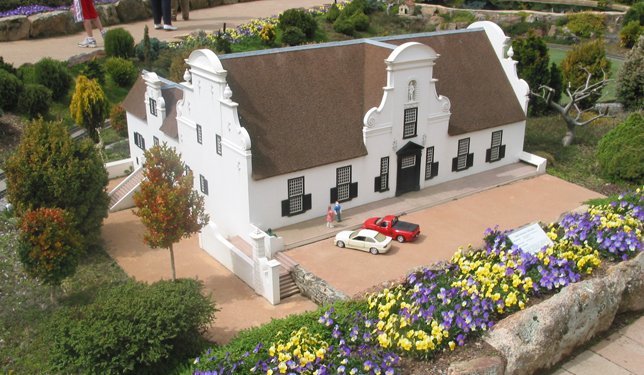
Groot Constantia is South Africa’s oldest wine estate dating back to 1685 when the land was first granted to Simon van der Stel, the last Commander and first Governor of the Cape Colony, the Dutch settlement at South Africa’s Cape of Good Hope. The land was granted to him during an annual visit to the Cape by Hendrik Adriaan van Rheede to Drakenstein, a military man and colonial administrator of the Dutch East India Company.
Van der Stel then built the classic Cape Dutch-style manor house and began to use the land to grow vines for wine production as well as growing other fruits and vegetables and farming cattle. Van det Stel’s original estate was broken into three parts following his death in 1712 and Groot Constantia continued to expand and develop as a wine estate under the ownership of the Cloete family until 1885. The estate was famous for its production of the Constantia dessert wine.
The magnificent manor house continued to be the centrepiece of the estate where wine production and wine experimentation continued. The manor house was destroyed by fire in 1925 and was subsequently fully reconstructed to its original Cape Dutch splendour from funds raised.
The manor house became part of the South African Cultural History Museum in 1969 and was subsequently passed into the ownership of the Groot Constantia Trust in 1993 and remains as a museum today.
Did you know:
Capital City: Cape Town is the Legislative Capital City of South Africa
Other Capital Cities: Pretoria (Executive), Bloemfontein (Judicial)
South African Population: 57.4 million
Population Density: 47 people per km²
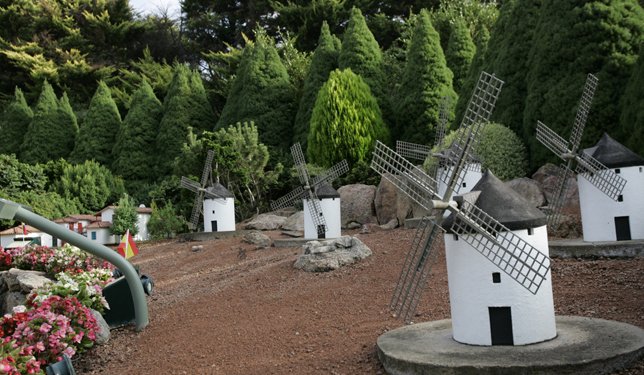
SPAIN – ESCENA DEL QUIJOTE
Location: Castilla-La Mancha
Sponsored by: Embassy of Spain
Model Construction by: Cockington Green Gardens
Scale: 1:18
Construction Time: Over 450 hours
Display History:
The windmills of the La Mancha region will be forever part of history because of the work of one of the world’s most famous and pre-eminent novelists, Miguel de Cervantes. It was the windmill setting in Cervantes’ great novel, El Ingenioso Hidalgo Don Quijote de la Mancha (or simply Don Quixote), where Quixote was warned by his companion that his enemy were indeed not giants but windmills.
“He gave the spur to his steed Rocinante, heedless of the cries of his squire, Sancho sent after him, warning him that most certainly
they were windmills and not giants he was going to attack.” Don Quixote De La Mancha, Part 1, Chapter 8
The windmills of the historic town of Consuegra with its 12th century castle have become a revered part of the Castilla-La Mancha windmill trail and provide a perfect window into Miguel de Cervantes’ great 17th century novel. The windmills were constructed to grind the grain (mostly wheat) of the millers and produce flour in this highly agricultural region. The windmills stopped being used at around the start of the 1980s.
Whilst de Cervantes did not specify exactly where Don Quixote “tilted” at the windmills, all the windmills of Castilla-La Mancha have some claim to the history associated with the great novel. The Don Quixote trail, beginning from the small town of Orgaz, south of the World Heritage Listed Toledo, through to Consuegra and beyond to Cuidad Real, allows the adventurous to relive the world of the most famous of all fictitious characters and tilt at the windmills which provide the region so much prominence.
Did you know:
Don Quixote’s Real Name: Alonso Quixano
Miguel de Cervantes: Born 29th September 1547 – Died 23rd April 1616
Don Quixote Novel: Part 1 published – 1605, Part 2 published – 1615
Windmills of Consuegra:12 still exist each with its own name
SULTANATE OF OMAN – JABRIN FORT
Location: Jabrin, Al Dakhiliyah Governate
Sponsored By: The Sultanate of Oman’s Ministry of Tourism & The Consulate General of the Sultanate of Oman
Model Construction by: Cockington Green Gardens
Scale: 1:43
Hours to Complete: 1000 hours
Display History:
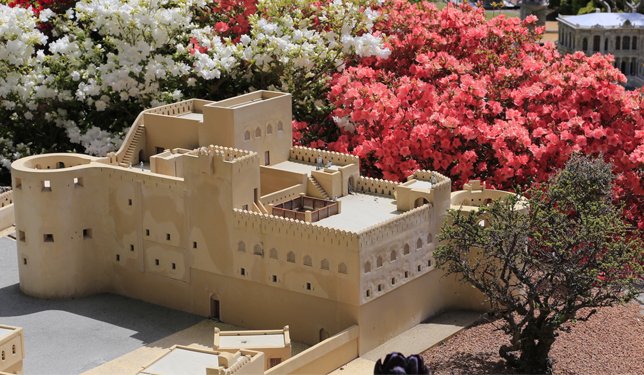
Forts and castles are Oman’s most striking cultural landmarks and, together with its towers and city walls, have historically been used as defensive bastions or look-out points, and often the seats of administrative and judicial authority. There are over 500 forts, castles and towers in Oman. Architectural styles vary, depending on the architects who designed them and the periods in which they were built.
The Jabrin Fort was built by Imam Sultan bin Saif Al Ya’arubi in 1670 as a summer residence and defensive stronghold. It is one of the most impressive forts in the Sultanate and the exquisitely decorated ceilings and carvings in the rooms and buildings are most elaborate.
Jabrin Fort began life as a castle but when Imam moved his capital from Nizwa to Jabrin two towers were added to complete its transformation into a fort. Included in the fort were rooms for Imam’s wives, guests and soldiers, a Mosque and Quran school on the rooftop. There was also a large date store, a spacious kitchen, a men’s and women’s prison and a beautiful courtyard. The Imam was buried in very modest tomb in the fort following his death in 1679.
Did you know:
Capital of Oman: Muscat (1.6 million)
Oman maritime borders: Iran and Pakistan
Area of Oman: 309,500km²
Density of Oman: 16 people per km²