International Display
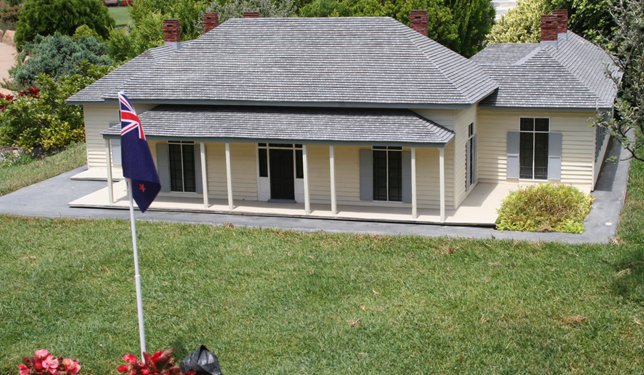
NEW ZEALAND – TREATY HOUSE
Location: Waitangi, Bay of Islands
Sponsored by: Mrs Fran James
With funding assistance from Aus-Industry Australian Tourism Development Grant
Model Construction by: Cockington Green Gardens
Scale: 1:18
Construction Time: 1250 hours
Display History:
The Georgian-style Treaty House has a rich and controversial history even preceding its construction in 1833-34 for the British Resident in New Zealand, James Busby. The original design of the property by John Verge was considered too extravagant by the New South Wales Governor and subsequently was halved in size following the intervention of colonial architect, Ambrose Hallen.
Just ahead of the 1934 centenary celebrations handing over the house to the nation by then Governor-General, Lord Bledisloe, major renovations and additions were made to the building. This saw what is now known as Treaty House increase around eight times in size from the original building occupied by James Busby in 1834. This might have been some atonement by architects William Gummer and William Page for Hallen’s earlier scaling down of the building.
The grounds of Treaty House in its various forms bear witness to the signing of two of New Zealand’s most significant documents, the Declaration of Independence of New Zealand in 1835 and the Treaty of Waitangi in 1840. The Treaty of Waitangi, the founding bi-cultural document of New Zealand, was signed by northern Maori Chiefs and Captain William Hobson, representing Queen Victoria of Great Britain.
The display at Cockington Green Gardens is sponsored by long-time supporter of the attraction and New Zealand national, Mrs. Fran James long with funding support through the Australian Government’s regional tourism program.
Did you know:
Waitangi Day: 6th February
Treaty House Heritage: Category 1 Listing on NZ Heritage List – 23 June 1983
Population of New Zealand: 4.8 million
New Zealand’s Largest City: Auckland (1.56 million)
NORWAY – BORGUND STAVE CHURCH
Location: Borgund, Laerdel
Sponsored by: Royal Norwegian Embassy
(Click through to Embassy website)
Model Construction by: Cockington Green Gardens
Scale: 1:18
Construction Time: More than 800 hours
Display History:
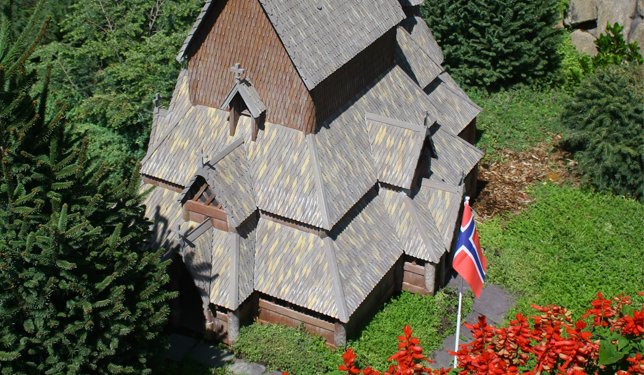
Built between 1180 and 1250 A.D. Borgund Stave Church is classified as a triple nave stave church and is no longer used for regular church functions but is now operated as a museum by the Society for the Preservation of Ancient Norwegian Monuments. The stave church name originates from the walls which are formed by vertical wooden boards or staves.
The church, built on a Basilica plan, is dedicated to St. Andrew and lies in narrow valley near Lærdel. The intricate design and construction has ensured longevity of this historic church which had another church erected next to it in 1868. The newer church assumed regular religious functions from the Borgund Stave Church which was sold to the Society for Preservation of Ancient Norwegian Monuments in 1877.
The stave church includes four carved dragons’ heads swooping from the carved ridge roof crests. Whilst not a part of the original structure, possibly additions during the 18th century, the dragons’ heads are best recalled from those found on the prows of Norse ships giving them their look of battle readiness. The church walls also have remnants of runic inscriptions on the walls of the west portal.
The architect of this inspiring church is unknown. Around the display at Cockington Green Gardens, there are plantings of several dwarf varieties of Norwegian spruces (picea abies) including ‘compacta asselyn’, ‘maxwelli’ and ‘little gem’.
Norwegian planting:
The gardens around our Borgund Stave Church are planted with several varieties of Dwarf Norway Spruce (Picea abies), including ‘Compacta Asselyn’, ‘Maxwellii’ and ‘Little Gem’.
Did you know:
Norwegian Income: 4th highest per capita income in the world
World Happiness Report: Norway ranked 1st (Un Sustainable Development Solutions Network)
Populations of Norway: 5.3 million
Area of Norway: 385,203km2
PERU – MACHU PICCHU
Location: Cuzco Region
Sponsored by: Embassy of the Republic of Peru
Model Construction by: Cockington Green Gardens
Scale: 1:100
Construction Time: More than 800 hours
Display History:
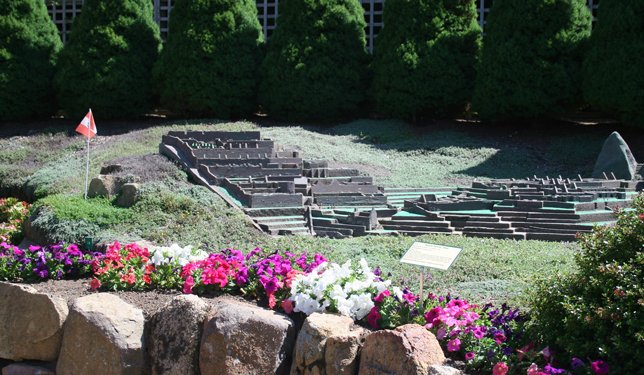
Variously described as remarkable and an engineering marvel, Machu Picchu which was built in the 15th century is considered one of the Seven New Wonders of the World according to a global poll in 2007. Mystery remains as to the reason for its construction with many archaeologists of the view that it was constructed as an estate for the Inca emperor, Pachacuti.
It is widely believed that Inca royalty, high priests and others retreated to Machu Picchu upon the arrival of the Spanish conquistadors led by Francisco Pizzaro in the early 1530’s. This wasn’t enough to save the Inca empire from eventual decline at the hands of Pizzaro and others who followed in his footsteps, although it is considered that the Inca empire was already in a state of weakness before the Spanish arrived.
Machu Picchu is built above the Urubamba River valley in a narrow saddle between two sharp peaks – Machu Picchu (old peak) and Hyuna Picchu (new peak). The site is around 7,710 feet (2,350 metres) above sea level possibly part explaining why it escaped Spanish detection after they took control of Cuzco just 50 miles away.
This current-day wonder was said to have only been occupied for around 80 years before being abandoned and not being rediscovered more than 300 years later by Yale University historian, Hiram Bingham in 1911. The abandonment of Machu Picchu is also a mystery although lack of water is cited as one of the reasons for its demise.
The model at Cockington Green Gardens is built to a scale of 1:100 and represents only part of the ruins of Machu Picchu.
Did you know:
World Heritage Listing: 1982
Area of Machu Picchu Site: 32,592ha
Abandoned by Incas: 1572
Inhabitants of Machu Picchu: Archaeological estimations at between 500 and 750 people at any one time
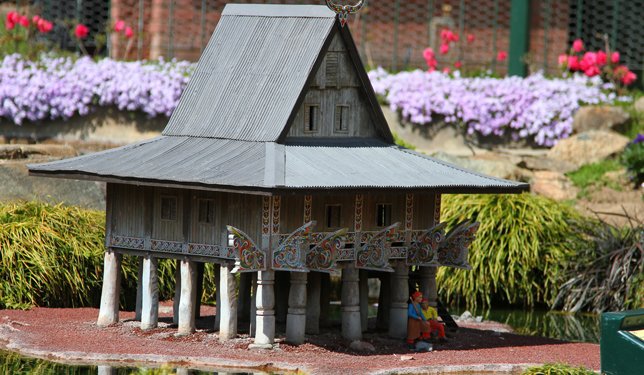
PHILIPPINES – TOROGAN MARANAO
Location: Southern Philippines
Sponsored by: Embassy of the Republic of the Philippines and the Filipino community in the ACT
Donated by: National Commission for Culture and the Arts of the Philippines
Model Construction by: Mr Noel E Escultura
Scale: 1:12
Construction Time: Unknown
Display History:
Maranao people have their origins in the Southern Philippines and are known as “people of the lake”. A Torogan is a traditional house and a symbol of high social status built for the Sultan or Datu (Village Chief) by the Maranao people. It is considered the highest form of a Maranao Royal House and the architecture used is the most aesthetic in the Philippines.
Despite the modern developments which have been introduced in the Maranao region, Torogans over 100-years-old can still be found today, the best examples in Dayawan and Marawi City and around Lake Lanao. The Torogan is distinctive in that it is the only one with an architectural feature of the panalong, a butterfly-like end beam protruding from the front of the house.
The architecture includes geometric flowing designs and folk motifs known as Okir carved into the panalong. Intricately designed Okir is either carved or painted with the geometric forms of plants, dragons or serpents prominent in Maranao artwork. The Torogan is elevated above the ground by columns cut from trees of huge girth. Those columns or posts rest on rocks which act as rollers to prevent earthquake damage in a region synonymous with seismic activity via its location on the Pacific Rim of Fire.
Did you know:
No. of Islands in Philippines: 7,641
Maranoa Population: 1.142 million people (1.25% of Philippine population)
Population of Philippines: 106.5 million
Origins of Philippines name: Named Las Islas Filipinas by Spanish explorer, Ruy López de Villalobos in 1543 in honour of Philip II of Spain.
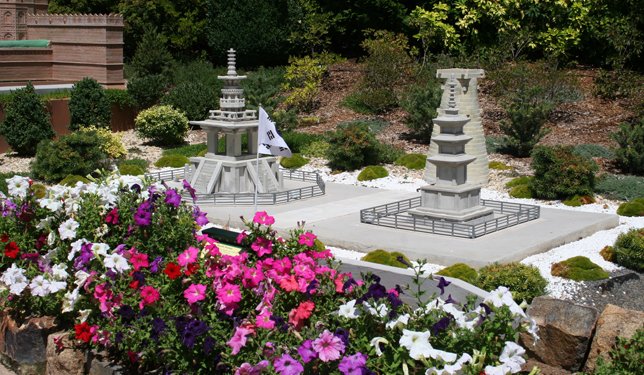
REPUBLIC OF KOREA – DAPOTAP AND SEOKGATAP PAGODAS, CHEOMSEONGDAE ASTRONOMICALl OBSERVATORY
Location: North Gyeongsang Province, South Korea
Sponsored By: Embassy of the republic of Korea (Website)
With funding assistance from Aus-Industry Australian Tourism development Program
Constructed by: Cockington Green Gardens
Scale: 1:18
Hours to Complete: 500 hours
Display History:
Dabotap Pagoda, the Pagoda of Many Treasures or of Multiple jewels, and Seokgatap Pagoda, the Sakyamuni Buddha Pagoda, are the two most famous features of the World Heritage Listed Bulguksa Temple located on the slopes of Mt. Toham. The site is classified as South Korea’s No. 1 Historic and Scenic site.
The Dabotap Pagoda and Seokgatap Pagoda are considered the most excellent specimens with their complex and ingenious architecture and their “profound philosophical depth and aesthetic charm.” Recognized as being inseparable and opposite, but complimentary eum-yang pair, a yin-yang pair. They stand together in view of the Buddha, offering a lesson in monumental stone for all who look at them.
Dabotap Pagoda, standing 10.4 metres high and built around 751 A.D., is considered as one of the most remarkable traditional structures in East-Asia. It is also No. 20 on South Korea’s list of National Treasures. Seokgatap Pagoda, also built around 751 A.D. and No. 21 on South Korea’s list of National Treasures, is 8.2 metres tall and the finest example of a typical Korean Buddhist pagoda. Both temples have experienced periods of extensive repair and refurbishment.
Cheomseongdae Astronomical Observatory was constructed in the 7th century under the reign of Queen Seondeok and is the oldest surviving astronomical observatory in Asia and possibly the world. Standing at 9.17 metres tall, the observatory consists of three parts and the name, Cheomseongdae means ‘star gazing platform’. The structure is said to contain much symbolism theorized to represent various historical and astronomical figures. The Observatory is No. 31 on South Korea’s list of National Treasures.
Did you know:
Bulguksa World Heritage: Listed in 1995
United Nations Admission: South Korea admitted to UN on 17th September 1991
Population of South Korea: 51.2 million
Capital City of South Korea: Seoul (9.8 million)